Lookup Tables
TBCompleted
The Genie Nano-10G cameras include a user programmable LUT table as a component of its embedded processing features. A LUT is used for operations such as gamma adjustments, invert and threshold processes.
The camera LUT table are dependent on the sensor (per pixel – see feature LUT Size) and is illustrated in the following figure (see Processing path bits per pixel). Pixel data from the sensor is passed through the LUT memory array, where the new programmed pixel value is then passed to the Genie Nano-10G output circuit. The LUT data table is stored along with other parameters with the user configuration function.
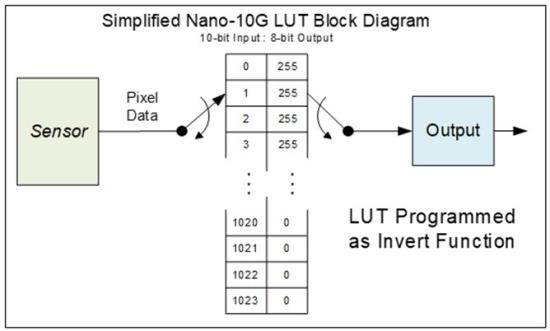
LUT Size vs. Output Pixel Format
The LUT size will be the same as the camera’s sensor pixel size; for the current Nano-10G standard firmware this is a 10-bit. All camera processing is performed at the 10-bit sensor pixel format of the camera, while the output pixel format is 8-bit.
The Nano-10G default neutral LUT programming is as follows:
With Output Pixel format = 8-bit, the default LUT data is programmed to map the 1024 sensor pixel values to 256 output values. Therefore, LUT indices 0 to 3 have value 0, LUT indices 4 to 7 have value 1, and so on until the last group where LUT indices 1020 to 1023 have value 255.
LUT data is selected as a predefined gamma correction, can be programmed with individual values for various LUT index entries or uploaded as a user LUT data file using the File Access controls. Refer to the Sapera documentation for information about the SapLut Class. Note that a SapLut file can be uploaded to the Nano-10G but cannot be read back.
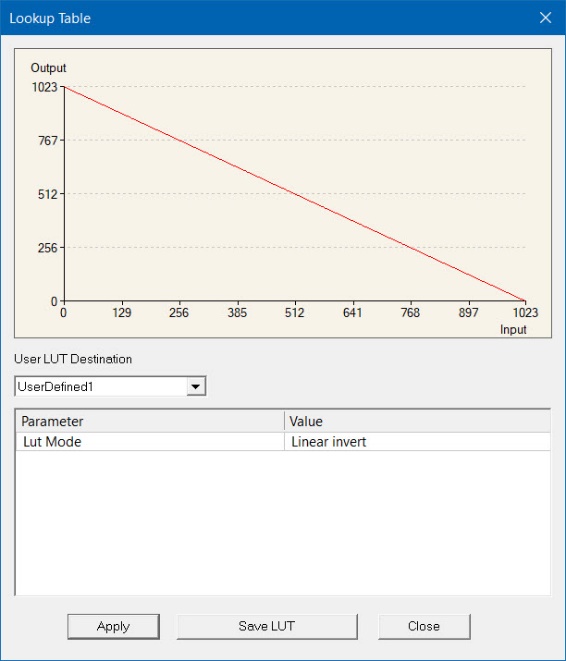
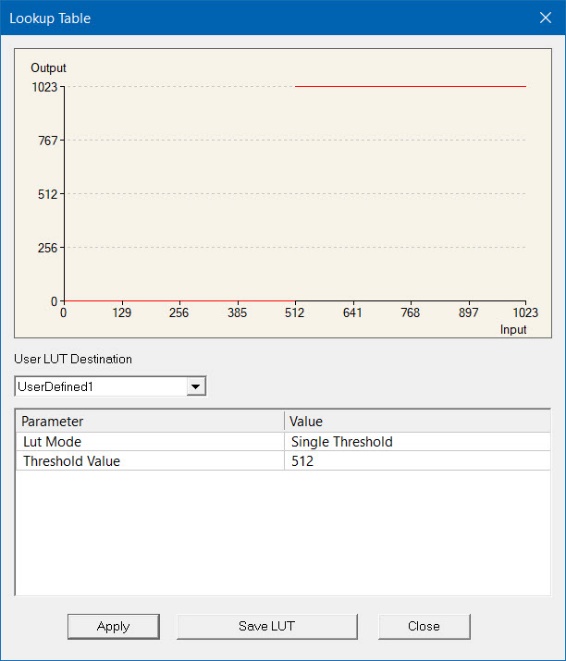
Note that CamExpert, through its Pre-Processing menu, allows you to enable and choose among a variety of predefined LUTs (invert, etc.). Select Lookup Table > Setting. LUTs may be saved through that dialog.
Gamma Correction Factor
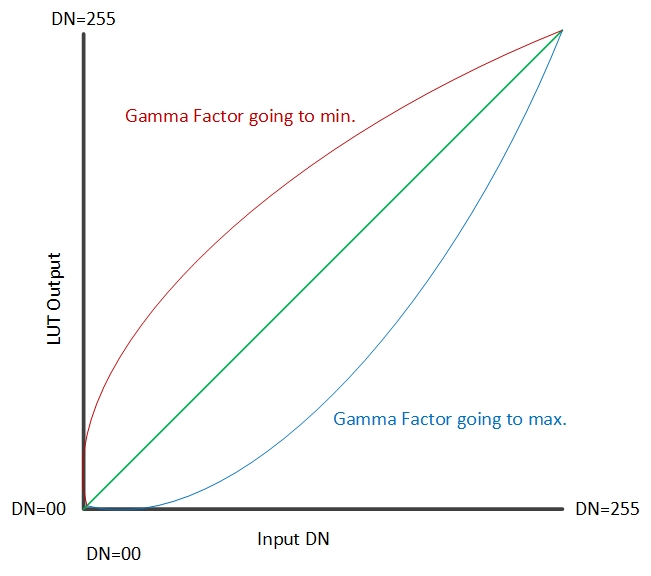
The following graphic shows LUT output data as a function of the gamma correction factor programmed by the user. An 8-bit LUT is shown as an example and importantly the graphic is not to scale.
-
As Gamma Correction is reduced in value to the minimum allowed, the nonlinear output of acquisition data through the LUT effectively boosts low value data.
-
As Gamma Correction is increased in value to the maximum allowed, the nonlinear output of acquisition data through the LUT effectively reduces low value data.
 ©
©